When Explainability Meets Uncertainty: The Idea Behind ICeX

This paper was born from a simple question I kept asking myself:

Can we really trust an AI model if we don’t know both why it makes a prediction and how sure it is about it?

In brain imaging, explainable AI and uncertainty quantification have often evolved in parallel worlds — one focusing on transparency, the other on reliability. I wanted to bring them together.

That’s how ICeX (Individual Conformalized Explanation) came to life: a framework that combines SHAP, for feature-level interpretability, and Conformal Prediction, for statistically valid uncertainty estimates. Together, they allow us to look at each prediction not only in terms of its causes, but also its confidence.

We tested ICeX on thalamic nuclei volumes from MRI scans of healthy young adults. The thalamus may not get as much attention as the cortex, but its subnuclei are incredibly sensitive to aging — and this finer anatomical detail turned out to matter.

The model reached a mean absolute error of 2.77 years and revealed the Left Lateral GeniculateLeft Paratenial, and Right Ventromedial nuclei as key contributors to brain aging. More importantly, it showed how each of these features influences not just the predicted brain age, but also the uncertainty around it.

For me, ICeX is a step toward a kind of AI that’s not just powerful, but also honest — an AI that tells you both what it thinks and how confident it is.

👉 Read the article in Computer Methods and Programs in Biomedicine

Neurodegenerative Disease Prediction: Impact of Imputation Techniques

The challenges posed by neurodegenerative diseases like Alzheimer’s and Parkinson’s demand sophisticated technological solutions to improve early diagnosis and patient outcomes. Central to these efforts is the effective handling of missing data in longitudinal studies, a common issue that can significantly impact the performance of predictive models.

Alzheimer’s Disease: Enhancing Prediction through Imputation Strategies

Based on the article: “Comparison between External and Internal Imputation of Missing Values in Longitudinal Data for Alzheimer’s Disease Diagnosis”

In the article “Comparison between External and Internal Imputation of Missing Values in Longitudinal Data for Alzheimer’s Disease Diagnosis,” Dr. Federica Aracri explored the impact of various imputation techniques on the accuracy of longitudinal deep learning models designed for predicting Alzheimer’s Disease (AD) progression. Utilizing data from the Alzheimer’s Disease Neuroimaging Initiative (ADNI), the study evaluated four models—Recurrent Neural Networks (RNN), Long Short-Term Memory (LSTM), DeepRNN, and ODE-RGRU—coupled with six imputation strategies, including advanced methods like MissForest and Multiple Imputation by Chained Equations (MICE).

The findings revealed that models such as ODE-RGRU and DeepRNN, when paired with external imputation techniques, significantly outperformed those relying on internal imputation. For instance, the combination of ODE-RGRU with median imputation achieved an mAUC value of 0.9 ± 0.002, and DeepRNN with MissForest reached an mAUC of 0.91 ± 0.004. These results underscore the critical role that robust imputation methods play in enhancing the accuracy of AD progression models.

Based on the article: “Imputation of Missing Clinical, Cognitive and Neuroimaging Data of Dementia using MissForest, a Random Forest Based Algorithm”

Another significant contribution by Dr. Aracri is the study presented in the article “Imputation of Missing Clinical, Cognitive and Neuroimaging Data of Dementia using MissForest, a Random Forest Based Algorithm,” where she assessed the reliability of the MissForest algorithm in handling missing data from Alzheimer’s Disease (AD) and Mild Cognitive Impairment (MCI) patients. The study compared MissForest with the commonly used Mean Imputation (Imean) method by simulating increasing levels of missing data in the ADNI dataset.

The research concluded that MissForest outperformed Imean in terms of overall imputation accuracy, particularly when considering the average error across all features. However, it was noted that MissForest had slightly higher errors than Imean for specific cognitive tests. These insights highlight the effectiveness of MissForest in handling missing data in dementia research, while also cautioning against its use with highly skewed variables.

Parkinson’s Disease: Classifying Phenotypes with Machine Learning

Based on the article: “Impact of Imputation Methods on Supervised Classification: A Multiclass Study on Patients with Parkinson’s Disease and Subjects with Scans Without Evidence of Dopaminergic Deficit”

Expanding on this work, Dr. Aracri also investigated the impact of imputation methods on supervised classification in the context of Parkinson’s Disease (PD). This study, detailed in the article “Impact of Imputation Methods on Supervised Classification: A Multiclass Study on Patients with Parkinson’s Disease and Subjects with Scans Without Evidence of Dopaminergic Deficit,” focused on the classification of PD, healthy controls, and a unique subgroup known as Scans Without Evidence of Dopaminergic Deficit (SWEDD). Two imputation approaches—MissForest and Mean Imputation (Imean)—were compared to assess their influence on the performance of tree-based algorithms, including Random Forest, XGBoost, and LightGBM.

The results demonstrated that while Mean Imputation occasionally led to overfitting, MissForest consistently retained more accurate information, proving to be the superior method for handling missing data in this context. This finding is particularly valuable for research into rare phenotypes of Parkinson’s Disease, where the accurate imputation of missing data is crucial for reliable classification outcomes.

Broader Implications and Future Directions

These works, conducted by Dr. Federica Aracri under my supervision, contribute significantly to the optimization of machine learning models for neurodegenerative disease research. The insights gained from these studies not only advance the understanding and prediction of diseases like Alzheimer’s and Parkinson’s but also have broader implications for other fields, particularly telemedicine. As healthcare continues to evolve with the integration of telehealth platforms, the methodologies developed in these studies could greatly enhance the reliability and utility of patient data collected remotely.

Moving forward, research will focus on incorporating additional biomarkers and conducting more extensive analyses to further refine these models. The ultimate goal is to improve early detection and personalized treatment strategies for neurodegenerative diseases, thereby enhancing patient outcomes on a global scale.

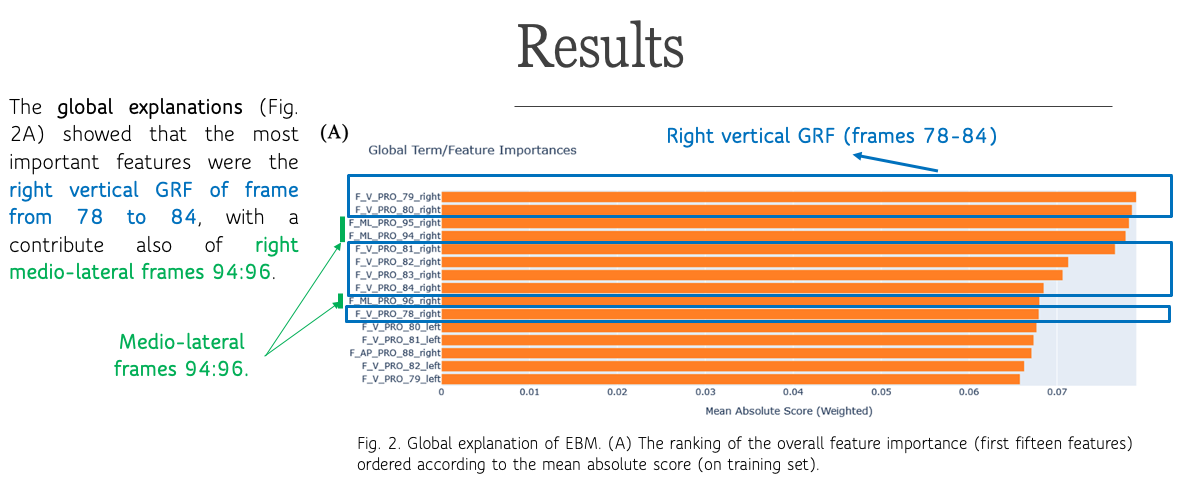
🚶‍♂️ Bringing Explainability to Gait Disorder Prediction with AI 🚶‍♀️

Highlights from our recent work, presented by Dr. Vera Gramigna at the Explainable AI for Biomedical Images and Signals Special Session of the 32nd Italian Workshop on Neural Networks (WIRN) 2024!

📄 Title of the Paper: Bringing Explainability to the Prediction of Gait Disorders from Ground Reaction Force (GRF): A Machine Learning Study on the GaitRec Dataset

Our research focuses on improving the prediction of gait disorders by analyzing ground reaction force (GRF) patterns using advanced machine learning techniques. We leveraged the GaitRec dataset, which includes GRF measurements from individuals with various musculoskeletal conditions, to develop a model that can distinguish between healthy controls and those with gait disorders.

What makes our work unique is the use of Explainable Boosting Machines (EBMs). Unlike traditional “black-box” models, EBMs provide transparency by showing which specific features of the gait data contribute to the predictions. This not only enhances the model’s accuracy but also allows clinicians to understand the reasoning behind each prediction, making AI tools more trustworthy and easier to integrate into clinical practice.

Key results:

  • Our model achieved an accuracy of 88.2% in predicting gait disorders.
  • We identified that specific frames of the right vertical GRF were crucial in distinguishing between healthy individuals and those with gait disorders.
  • The model’s explainability also revealed potential areas of improvement, such as the challenge in accurately classifying healthy controls, likely due to the diversity within the gait disorder category.

This work is a step forward in combining AI with clinical expertise, paving the way for more precise and understandable diagnostic tools in healthcare.

#AI #MachineLearning #GaitAnalysis #ExplainableAI #BiomedicalEngineering #WIRN2024

Advancing Alzheimer’s Risk Prediction with Explainable AI: Insights into Sex Differences

I’m thrilled to share our latest research, recently published in Brain Informatics and Brain Sciences. Our studies focus on enhancing the prediction of Alzheimer’s disease (AD) progression from mild cognitive impairment (MCI) using advanced explainable AI techniques.

In Brain Informatics, we demonstrated how Random Survival Forests (RSF) combined with SHapley Additive exPlanations (SHAP) improve the accuracy and interpretability of predicting AD conversion risk. Key biomarkers like FDG-PET, ABETA42, and the Hypometabolic Convergence Index (HCI) emerged as critical factors.

Building on this, our Brain Sciences article delves into the sex-specific differences in AD risk prediction. We found that while men and women share common influential biomarkers, significant differences exist in the importance of hippocampal volume and cognitive measures such as verbal memory and executive function. Our models revealed that females generally have a higher predicted risk of progressing to AD, emphasizing the need for sex-specific diagnostic approaches.

These studies underscore the potential of combining neuroimaging with explainable AI to enhance early diagnosis and personalized treatment for Alzheimer’s patients.

#AlzheimersDisease #AIinHealthcare #Neuroscience #SexDifferences #BrainHealth #MedicalResearch

🧠 Understanding Brain Aging in Parkinson’s Disease: A New Diagnostic Approach 🧠

I’m excited to share our latest research, presented at the Explainable AI for Biomedical Images and Signals Special Session of the 32nd Italian Workshop on Neural Networks (WIRN 2024)! Our work focuses on the crucial role of the thalamus in Parkinson’s disease (PD) and how deviations between brain age and chronological age—known as the brain-age gap (BAG)—can offer insights into disease progression.

Using MRI scans and advanced Explainable Boosting Machines (EBM), we’ve developed a novel, interpretable machine learning model that accurately estimates BAG in PD patients. Our findings reveal a complex pattern of hypertrophy and atrophy in thalamic nuclei volumes in PD patients, highlighting specific nuclei as key predictors of brain age. This approach not only improves early diagnosis and prognosis but also opens doors to personalized treatment plans for those with Parkinson’s disease.

This research underscores the potential of combining neuroimaging with cutting-edge AI to enhance our understanding of neurological disorders. Stay tuned for more updates on how this could revolutionize PD diagnosis and treatment!

#ParkinsonsDisease #BrainHealth #AIinHealthcare #Neuroscience #MRI #MedicalResearch #WIRN2024

Attached the powerpoint presentation.

Brain Informatics 2022 – My oral communication

Ever wondered how to quantitatively compare feature importance produced by Machine Learning algorithms?

In this new work presented at the Brain Informatics 2022, we introduce the Rank-Biased Overlap (RBO) as similarity measure for comparing rankings of features ordered by their importance. We used the automatic classification of Parkinson’s disease as case study.

Take a look at my recording if you are curious!

Waiting for the MICCAI 2014

I’m going to leave for Boston in few days, and I’m really excited ’cause I’ll present my new work on advanced feature selection at the MIT!

The MIT, a place I’ve only dreamed on 🙂 

Anyway, my work has been accepted at the MICCAI 2014, in the contest of the CADDementia challenge.

If you want more details about my algorithm, I’m writing the official wiki page of the competition.