Imagine a model that estimates the brain age of a patient from an MRI scan and returns: 68 years. Is that useful? It depends on something the number alone does not tell you: how wrong could it be?
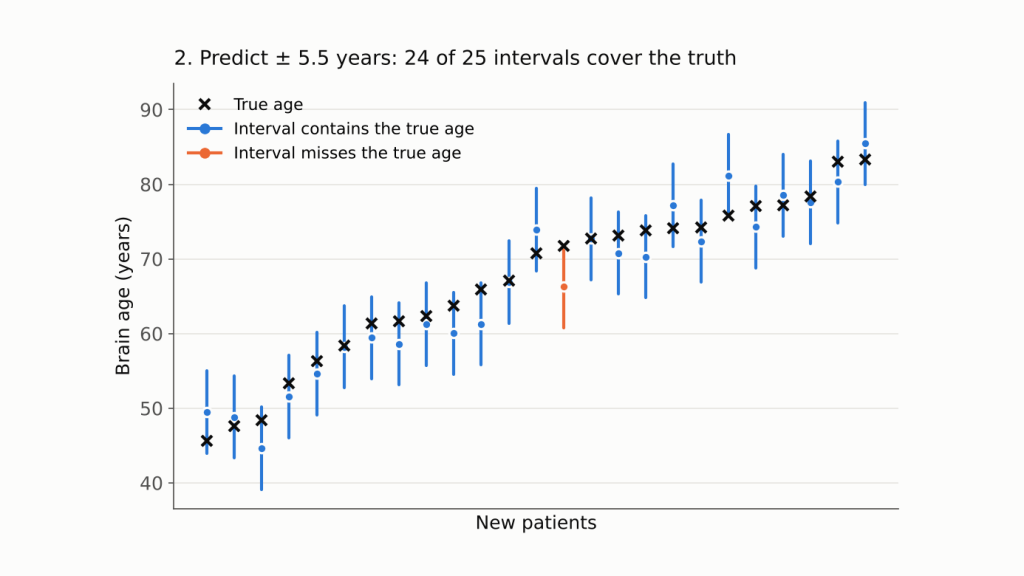
Now imagine the same model returning: 68 years, with a 90% prediction interval between 62 and 74. That is a different kind of information. It tells you what the model thinks and how much room for error there is around it. Conformal prediction is a simple and rigorous way to produce exactly this kind of output.
This post focuses on regression, where the model predicts a number, such as brain age or a clinical score. Classification, where the model predicts a diagnosis, works differently and will be the subject of a second post.
The idea, without equations
The most common version, called split conformal prediction, works in three steps:
- Train any model on part of the data, as usual.
- Calibrate it on a separate set of patients the model has never seen. For each of them, measure how far the prediction was from the truth.
- Predict for a new patient, and build an interval wide enough to cover the errors observed in, say, 90% of the calibration patients.
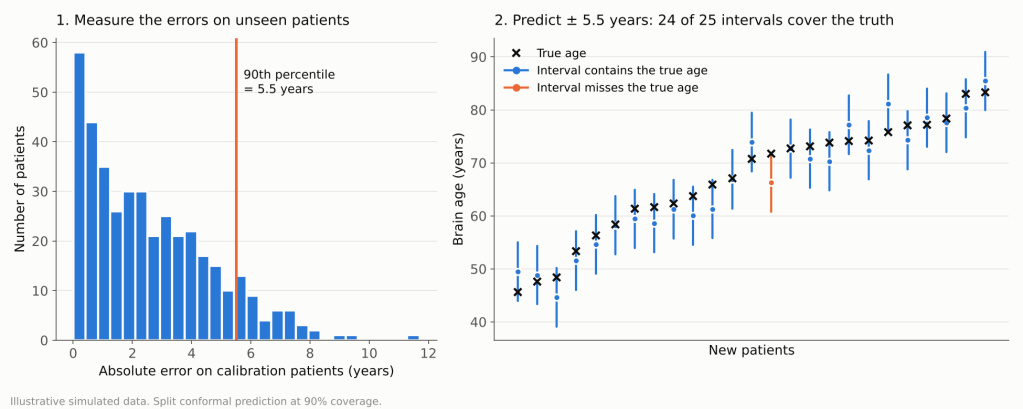
That’s it. The model is not modified, so it works with Random Forests, boosting, neural networks or any other algorithm.
What it guarantees
The strength of conformal prediction is its guarantee. If new patients come from the same population as the calibration patients, then intervals built at 90% will contain the true value for at least 90% of them. This holds regardless of the model and without assuming that errors follow a normal distribution or any other particular shape. Few uncertainty methods offer a guarantee this clean.
What it does not guarantee
This is the part clinicians should know well, because it is where the method is most often misunderstood.
- The guarantee is on average, not for every patient. Across all patients, 90% of intervals contain the truth. For a specific subgroup, such as older women or patients scanned on a different machine, coverage could be higher or lower. Variants of the method can provide coverage within predefined subgroups, and they should be used when subgroups matter.
- It depends on the population. If the model is used on patients who differ from the calibration set, for example a different hospital or scanner, the guarantee no longer holds automatically. The model should be recalibrated on local data.
- It does not make a bad model good. A poor model will simply produce very wide intervals. This is honest, but not useful.
Why the width of the interval matters
In the simplest version, all intervals have the same width. More refined versions, for example those based on quantile regression, adapt the width to each patient: narrow when the case is typical, wide when it is unusual. In my experience, this is where conformal prediction becomes clinically interesting. An unusually wide interval is a flag. It says: this patient does not look like the ones the model learned from, so look more carefully.
In brain age estimation, this makes a real difference. A brain age gap of five years means something very different when the interval is two years wide than when it is fifteen years wide.
This is the approach we took in our own brain age work: conformal prediction with quantile regression forests, which produces patient-specific intervals (Sarica et al., LNCS, 2025), later combined with explanations in the ICeX framework (Sarica et al., Computer Methods and Programs in Biomedicine, 2026).
Three questions to ask
Next time you read a study, or evaluate a tool, that uses conformal prediction, ask:
- Was the calibration set separate from the training data, and similar to the patients I see?
- Was coverage checked in the subgroups that matter, not only overall?
- Are the intervals narrow enough to be useful for a clinical decision?
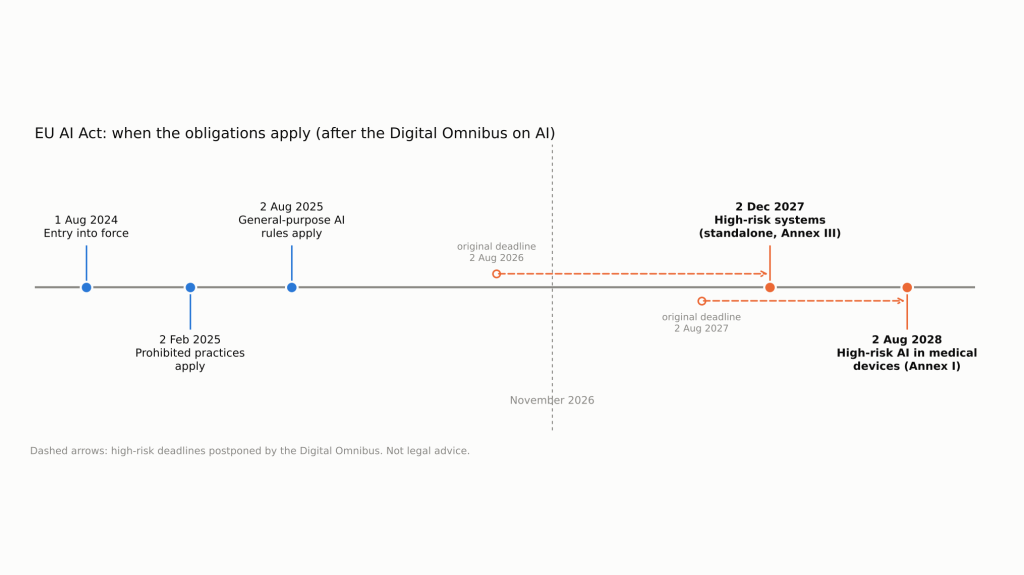
If the answer to all three is yes, you have a model that does not just give an answer, but also tells you how much to trust it. Combined with explanations of why the model made a prediction, this is what I believe trustworthy clinical AI should look like. It is the idea behind ICeX, and it is also increasingly what regulation expects, as I discussed in my previous post on the AI Act.
If you want a more complete overview of explainability and conformal prediction in neurodegenerative disease assessment, you can find it in my chapter in the book Behavioral Biometrics and Artificial Intelligence for Neurodegenerative Diseases Assessment.
In the next post of this series, I will look at classification, where conformal prediction no longer returns an interval but a set of possible diagnoses.


Leave a Reply