If you have followed this blog for a while, you know I have a soft spot for Generalized Additive Models, or GAMs. The idea is simple and, for clinical use, very powerful: the model adds up the effect of each variable separately, and each effect is a curve you can actually look at. No black box to open afterwards, the explanation is the model itself.
But “GAM” is a family, not a single algorithm. In our recent paper, published in the Brain Informatics 2025 proceedings (Springer LNAI), we compared two modern members of that family on the same clinical question.
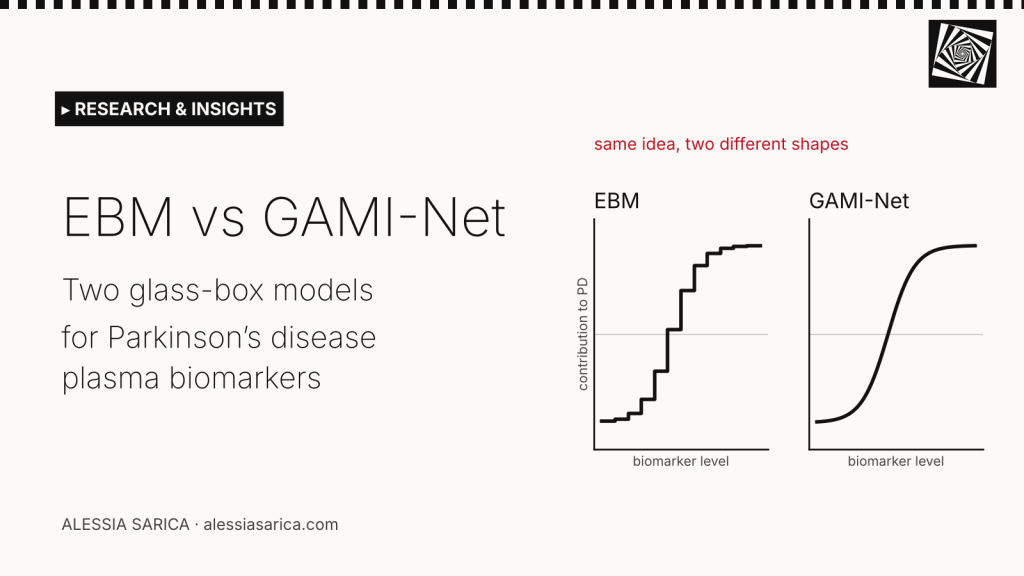
Same idea, two different engines
- Explainable Boosting Machine (EBM), from Microsoft’s InterpretML, learns each curve with many small boosted trees. Its curves look like staircases, and it can add a few pairwise interactions between variables.
- GAMI-Net learns each curve with a small neural network, with structured pairwise interactions. Its curves are smoother.
Both are “glass-box” models. The question was: on real clinical data, do they behave the same way?
What we did
We classified people with Parkinson’s disease versus healthy controls using plasma biomarkers from the BioFIND cohort. Both models were built with the PiML Python toolbox, on an 80/20 train-test split with grid search. We did not stop at accuracy: we also looked at calibration (can we trust the predicted probabilities?), robustness to small perturbations of the inputs, resilience to shifts in the data, and of course at the explanations, both global and for single patients.
What we found
- Both models performed well. GAMI-Net was slightly better on the test set (accuracy 0.86 vs 0.84, AUC 0.94 vs 0.90).
- Both pointed to the same key biomarkers: homovanillic acid, a dopamine metabolite, and N-acetylputrescine. When two different models agree on what matters, I trust the finding a little more.
- EBM was more robust to noisy inputs and better calibrated. GAMI-Net generalized better and captured nonlinear interactions more flexibly.
So, no single winner. The two models have complementary strengths, and the right choice depends on what you need most: reliable probabilities and stability, or flexibility. Which is, after all, a very clinical answer.
The part I am proudest of
This paper was led by my PhD student Chiara Camastra, from the PhD programme in Digital Technologies Applied to Medicine. And it was born from the Bachelor’s thesis of Gioele Maria Pullano. It is not every day that a Bachelor’s thesis turns into a paper in Springer proceedings: it takes real commitment, and Gioele fully deserved his place among the authors.
Reference: Camastra, C., Novellino, F., Pelagi, A., Pullano, G. M., Quattrone, A., & Sarica, A. (2026). Interpretable Machine Learning for Parkinson’s Disease: Biomarker-Based Comparison of EBM and GAMI-Net. Lecture Notes in Computer Science, 16347 LNAI, 311-321. doi:10.1007/978-981-95-9575-4_24



Leave a Reply