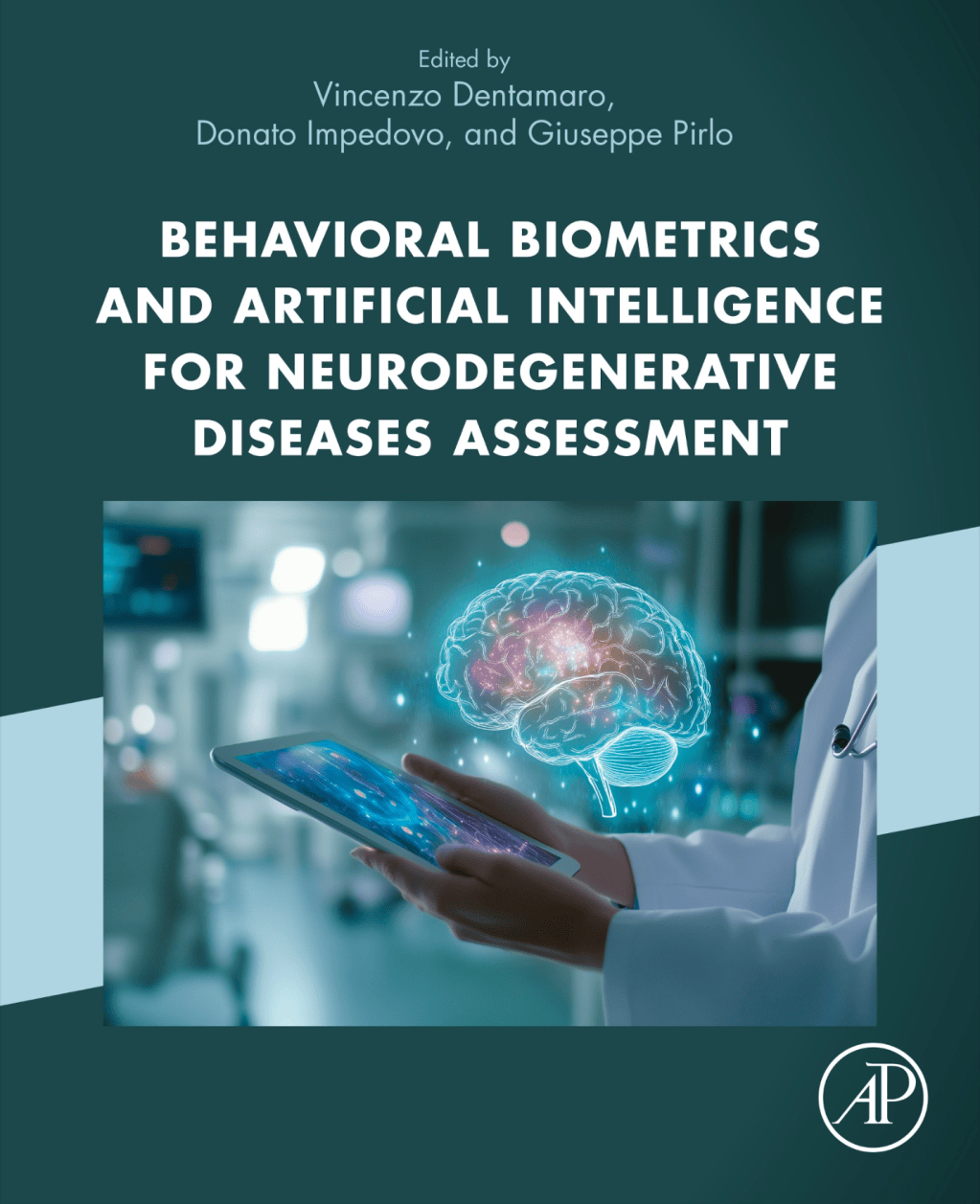
I am happy to share that the book Behavioral Biometrics and Artificial Intelligence for Neurodegenerative Diseases Assessment, edited by Vincenzo Dentamaro, Donato Impedovo and Giuseppe Pirlo of the University of Bari Aldo Moro, has been published by Academic Press (Elsevier, 2026).
The book brings together clinicians and computer scientists around a shared question: how can artificial intelligence help us assess neurodegenerative diseases, from wearable sensors and gait to handwriting, speech and neuroimaging? I contributed two chapters, on two topics that are often treated as technical details but that, in my experience, decide whether a model can be trusted at all.
Chapter 12: Explainable techniques for trustworthy artificial intelligence
With Vera Gramigna. This chapter starts from a dilemma familiar to anyone working in medical AI: the most accurate models are often the hardest to understand. We review the main families of explainable AI methods, from models that are interpretable by design to model-agnostic techniques that can explain any classifier, and we show how they have been applied to the assessment of neurodegenerative diseases using gait, neuroimaging, handwriting and speech.
Two ideas run through the chapter. The first is the Rashomon effect: many different models can reach similar performance while relying on very different features, which is why explanations should be compared, not taken at face value. The second is that explainability alone is not enough. A transparent prediction still needs to say how reliable it is. For this reason, the chapter closes with uncertainty quantification and, in particular, conformal prediction, and argues for frameworks that combine explanations and uncertainty in a single picture.
📖 doi.org/10.1016/B978-0-443-13545-3.00012-8
Some of the ideas in this chapter come from our own research: comparing feature importance rankings across models with the rank-biased overlap (Sarica et al., 2022), explaining survival models for conversion from mild cognitive impairment to Alzheimer’s disease (Sarica et al., Brain Informatics, 2023), and combining explanations and conformal prediction in brain age estimation (Sarica et al., CMPB, 2026).
Chapter 13: Handling missing data in the assessment of neurodegenerative diseases
With Federica Aracri. Clinical, cognitive and imaging datasets are almost never complete. Patients drop out, long cognitive assessments are left unfinished, and multicenter or international databases follow different protocols. Telemedicine has made cognitive profiling more accessible, but it has also brought new sources of incomplete data.
The chapter explains why the mechanism behind missing values matters, distinguishing data that are missing completely at random, at random, or not at random, and why the last two are so hard to tell apart in practice. It then reviews strategies for dealing with them, from data cleaning and classical statistical imputation to machine learning approaches. We close with the open problems that, in my view, deserve more attention: extreme missingness in costly or invasive measures, multimodal and longitudinal data, cross-cohort variability and, once again, the uncertainty that imputed values carry with them into every downstream analysis.
📖 doi.org/10.1016/B978-0-443-13545-3.00011-6
The chapter builds on the research line we have developed with Federica on imputation in dementia and Parkinson’s disease: missForest for clinical, cognitive and neuroimaging data (Aracri et al., 2023), the impact of imputation on multiclass classification (Aracri et al., 2023), external versus internal imputation in longitudinal data (Aracri et al., 2024), and the effect of imputation on dementia classification performance (Aracri et al., Brain Sciences, 2025).
A common thread
Read together, the two chapters make the same point from different angles. Whether a model is trustworthy depends not only on its accuracy, but on whether we understand what it does, how sure it is, and what happened to the data before it was trained. In the coming weeks I will expand on some of these themes in a short series on this blog, starting with what the European AI Act means for neuroimaging models and continuing with conformal prediction explained for clinicians.
Many thanks to the editors for the invitation, and to Vera and Federica for their work on these chapters.



Leave a Reply